


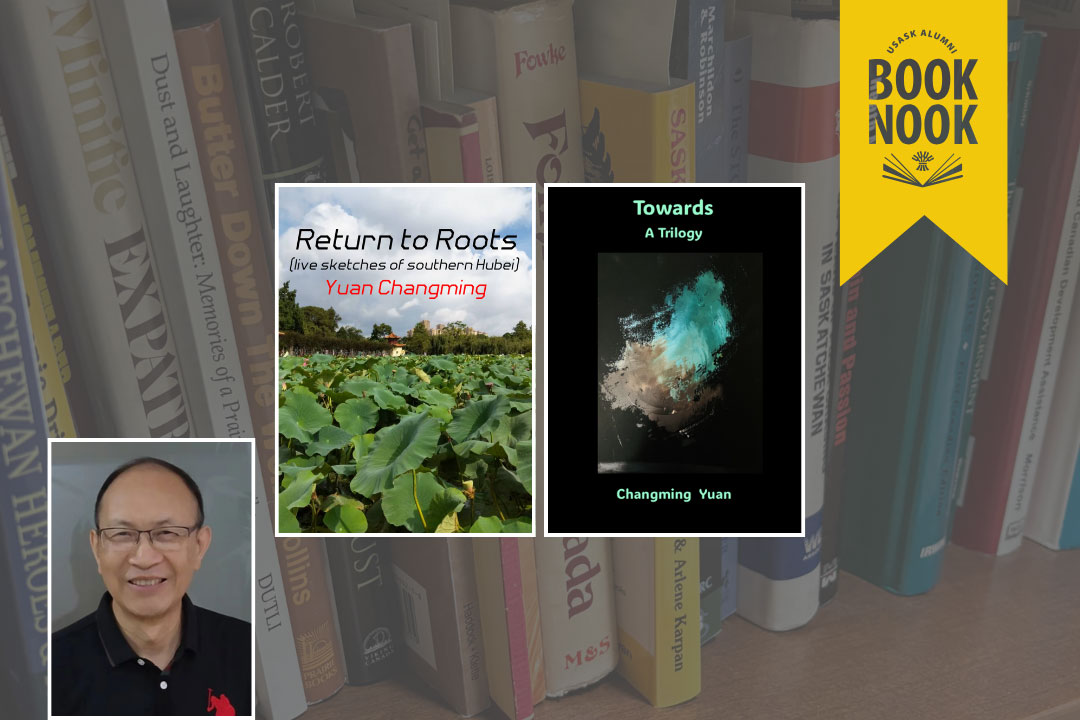
Alumni Book Nook: Dr. Yuan Changming (MA’92, PhD’96)
In February 2026, USask graduate Dr. Yuan Changming released a collection of essays and a novel trilogy
University of Saskatchewan (USask) graduate Dr. Yuan Changming (MA’92, PhD’96) is an award-winning poet, writer, editor, publisher, tutor, and translator.
Over the course of his literary career, Changming has earned multiple international poetry prizes, including 12 Pushcart nominations for poetry and three for fiction. He has also been included in Best Canadian Poetry (2009, 2012, 2014) and the Best of the Best Canadian Poetry (2008-17) as well as in literary publications across 51 countries. In 2021, he served as a juror for Canada’s 44th National Magazine Awards (poetry category) and in 2025 he released two new books: The Tuner: 16 most moreish days in a lifetime and Flashbacks: a collection of hyperrealisitic narratives.
Before relocating to Canada and studying at USask, Changming grew up in an isolated village in China. He began to learn the English alphabet in Shanghai at the age of 19. After earning his Master of Arts and PhD degrees in English at USask in 1992 and 1996, respectively, he moved to Vancouver, B.C. He continues to live and write in Vancouver, where he has co-founded an online literary publication, Poetry Pacific, with his son, Allen Yuan. His positive experiences at USask inspired him to donate to his alma mater after graduation, and he worked with the College of Arts and Science to establish an annual award open to English majors who have written a Canadian literature essay for a USask English class.
“USask helped develop and sharpen my writing skills,” Changming said.
In February 2026, Changming released Return to Roots, a collection of 20 essays (published by Alien Buddha Press), and Towards: A Trilogy, a novel trilogy (published by Silver Bow Publishing). The Green&White asked Changming about his new books and his education at USask.
What inspired you to write Return to Roots?
(I was inspired by) my annual sojourn to my native place, Jingzhou (in China).
What are five adjectives that you would use to describe Return to Roots?
Nostalgic, realistic, local, cultural, and traditional.
What is the focus of Towards: A Trilogy?
The central hook is a fundamental question of the soul: What happens after one achieves the “Canadian Dream”? I want readers to ponder whether happiness is merely success, or if it requires something deeper.
In my view, the “dream” provides the material foundation, but love and spiritual growth form the superstructure of happiness. To reach this higher state, Ming must follow a specific trajectory: he must detach from the material “red dust,” derail from conventional relationships to find raw love, and detour through the natural world to harmonize his spirit. Happiness is the immediate goal, but spiritual wholeness is the ultimate purpose of life.
What inspired you to write Towards?
(I was inspired by) my rekindled affection for my first crush I reencountered in 2019, after 42 years of separation without knowing each other’s whereabouts.
Why would you recommend Towards to USask alumni?
I recommend my trilogy, Towards, for three primary reasons that resonate with our shared academic and cultural identity.
Many of us came to the prairies—or stayed there—to build a foundation of success. Towards asks the haunting question that follows that achievement: What happens after the "Canadian Dream" is realized? For alumni who have spent decades building careers and reputations, this book explores the “Superstructure of Happiness”—the shift from professional success to the urgent quest for spiritual wholeness and meaning in our “silver years.”
Our university prides itself on rigorous scholarship and creative innovation. Towards is a hybrid, encyclopedic, and teleological work that defies genre. It integrates poetry, drama, letters, and philosophy into a single narrative arc. To an audience trained to appreciate complex structures and intellectual depth, this trilogy offers a reading experience that is as intellectually demanding as it is emotionally rewarding.
USask is an institution that connects the local to the global. My journey—from a survivor of the Cultural Revolution who learned the English alphabet at 19 to a Canadian PhD holder—is a testament to the transformative power of education in this country. Towards bridges the “red dust” of my origins in China with the intellectual freedom I found in the West, offering a Trans-Pacific perspective that reflects the diversity and global reach of our alumni network.
Is there anything else you would like to add?
I am always grateful to USask for the opportunity to get the education I wanted!