


Fascinated by physics
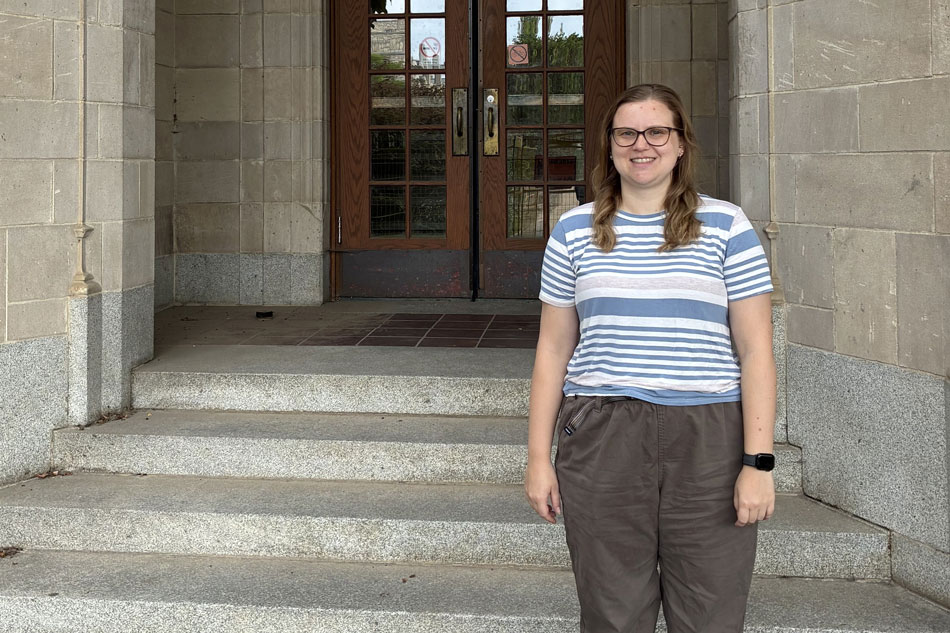
USask postdoctoral researcher and alumna Dr. Kimberlee Dube (BSc’16, MSc’19, GPSC’19, PhD’23) is examining how human-caused climate change can affect Earth’s atmosphere
By SHANNON BOKLASCHUKIt was a deep interest in understanding weather and climate that first prompted Dr. Kimberlee Dube (BSc’16, MSc’19, GPSC’19, PhD’23) to sign up for physics classes at the University of Saskatchewan (USask).
Dube, who graduated from St. Joseph High School in Saskatoon, had planned on becoming a meteorologist. However, the undergraduate physics classes she took at USask’s College of Arts and Science inspired her to take part in summer research activities related to space weather. That research led Dube to USask’s Institute of Space and Atmospheric Studies (ISAS) and eventually to graduate school, “because of the excellent research opportunities in atmospheric physics” that are available at the university, she said.
In total, Dube earned three degrees at USask—a Bachelor of Science degree in physics in 2016, a Master of Science degree in physics and engineering physics in 2019, and a PhD in physics and engineering physics in 2023—as well as the Graduate Professional Skills Certificate in 2019. Today, she is a postdoctoral fellow in physics and engineering physics at USask, supervised by Dr. Susann Tegtmeier (PhD).
“I am always amazed by the way that physics can be used to explain super complicated processes that govern everyday life,” Dube said. “Specifically in my field, we have very complex climate models that can describe the evolution of the whole atmosphere-ocean system using physics.”
Dube’s current research is focused on understanding the long-term signatures present in the OSIRIS ozone and nitrogen dioxide data records. OSIRIS, the USask-designed and built Optical Spectrograph and InfraRed Imaging System, is deployed and in operation aboard the Swedish Odin satellite. Dube works directly with the data that OSIRIS and other satellite instruments collect to analyze changes to Earth’s atmosphere—which can have significant impacts on life on Earth. Her research is enhanced through close collaborations with international modelling and satellite instrument groups.
The Green&White recently caught up with Dube to talk about her USask education, her current work as a postdoctoral researcher, and her advice for other USask students who may want to study physics.
Green&White: What are some of your fondest memories from your time as a USask student?
Dube: The main highlight in undergrad was the CaNoRock (Canada-Norway Student Sounding Rocket) course, when I went to Northern Norway with an international group of students to build and launch an atmospheric sounding rocket. That was my first time in Europe, and it was really special to spend a week meeting new people and working closely on such an interesting project. I also really enjoyed the travel opportunities that I had as a grad student, including a semester at the University of Helsinki, visiting the National Center for Atmospheric Research in Boulder, Colorado, for a few months, and presenting my research at NASA Langley.
G&W: You are now a postdoctoral fellow at USask. What is the focus of your current research?
Dube: My research is primarily focused on understanding how anthropogenic climate change is affecting the middle atmosphere. More specifically, I study how emissions of carbon dioxide, nitrous oxide, and halogenated gases impact the chemical composition and thermal structure of the stratosphere. These substances are of particular interest as they can contribute to the destruction of the stratospheric ozone layer and to temperature changes. I am also interested in studying how natural disasters, such as volcanic and wildfire events, impact the upper troposphere and stratosphere. The aerosols released by these events can reach the stratosphere, where they alter the chemical composition and radiative forcing. I do this work using satellite observations and climate models.
G&W: Why did you decide to be a postdoctoral researcher at USask?
Dube: There is so much great research happening in atmospheric physics! Despite being a relatively small group, the atmospheric physics faculty at USask has expertise in all steps of the research process, including instrument design, algorithm and model development, data processing, and higher-level climate science. It is quite rare to find a place where you can be involved in all of this.
G&W: You a part of a team that recently discovered unexpected data that shows the chlorine in the stratosphere is not decreasing as quickly as we would expect based on ground measurements. What is the significance of this data?
Dube: The stratospheric ozone layer shields the Earth from harmful solar ultraviolet radiation. In the 1980s, scientists discovered that stratospheric ozone levels were dropping, and this was attributed to emissions of human-produced chemicals, including chlorinated chemicals like chlorofluorocarbons (CFCs), which were used in refrigerators, air conditioners, and spray cans. The global community came together to enact the Montreal Protocol in 1987 to limit the production and emission of CFCs and other ozone-destroying chemicals.
The Montreal protocol should lead to a decrease in stratospheric chlorine. To verify this, scientists use a network of ground-based instruments to measure chlorine emissions from the surface, along with satellite instruments to monitor the stratospheric chlorine concentrations. My research compared these datasets and found that the decrease in the amount of total stratospheric chlorine is smaller than the decrease in emissions of chlorine-containing gases. This is of concern because it shows that the ozone layer is not recovering as expected. We determined that the culprit is chlorinated very short-lived substances (Cl-VSLSs), a type of chemical that is not regulated by the Montreal Protocol, which focused on long-lived gases. Without regulation of Cl-VSLSs emissions, which are increasing by about 2.5 parts per trillion each year, the ozone layer will take longer to return to the levels it was at prior to human interference.
G&W: Why is it important to study the atmosphere and take atmospheric measurements?
Dube: We all live in the atmosphere, and it controls the ability of life to thrive. It’s clear that the climate is changing. We can see it happening: the more frequent tornadoes this summer, the extreme wildfires every year, more frequent heat waves, etc. These events have significant consequences for life on Earth. The only way to really understand what is happening in the atmosphere is with measurements, which have been used to show that climate change is caused by anthropogenic emissions of greenhouse gases.
The case of the ozone layer is largely a success story, in which measurements of the atmosphere were used to identify a problem that could then be solved through international collaboration. Unfortunately, climate change has become a more decisive topic, despite what that data shows.
G&W: What impact do you hope your research will have in the future?
Dube: I am excited to work with data from the new HAWC (High-altitude Aerosols, Water vapour and Clouds) satellite, which will make measurements that can be used to improve our understanding of high-altitude clouds, aerosol, and water vapor. These parameters are some of the biggest unknowns in the atmosphere, and our current inability to model them is a limitation for weather forecasting and climate prediction. Two of the three scientific instruments on HAWC are being developed at USask.
I am also interested in doing more research on the impacts of the recent wildfires on the atmosphere. The severity and frequency of the wildfires has clearly been increasing, and some of these fires are large enough to inject smoke directly into the stratosphere. Once there, the smoke can be transported globally and alter the temperature and chemical composition. This, in turn, can have consequences for the ozone layer, as some of the chemistry that contributes to ozone destruction is enhanced in the presence of smoke particles. It is important to understand these impacts given that frequent wildfires are becoming the new norm.
G&W: What is your advice for other USask students who may want to follow in your footsteps and study physics and conduct atmospheric research?
Dube: I think that lots of people fear physics, and think that they aren’t smart enough, but that isn’t true! I was never as good as some of my classmates at the more technical work, but that isn’t necessarily the most important thing at the graduate level and beyond. Being able to work well in a team and presenting information in a clear way are super valuable skills when it comes to actually doing physics research.
My other advice is to talk to professors and get started doing research early if it interests you. I have been working on research projects since my second year in undergrad, which allowed me to try out a few different areas of physics before settling on a field for my PhD. This also meant that I knew that I enjoyed doing research before committing to a PhD program.