


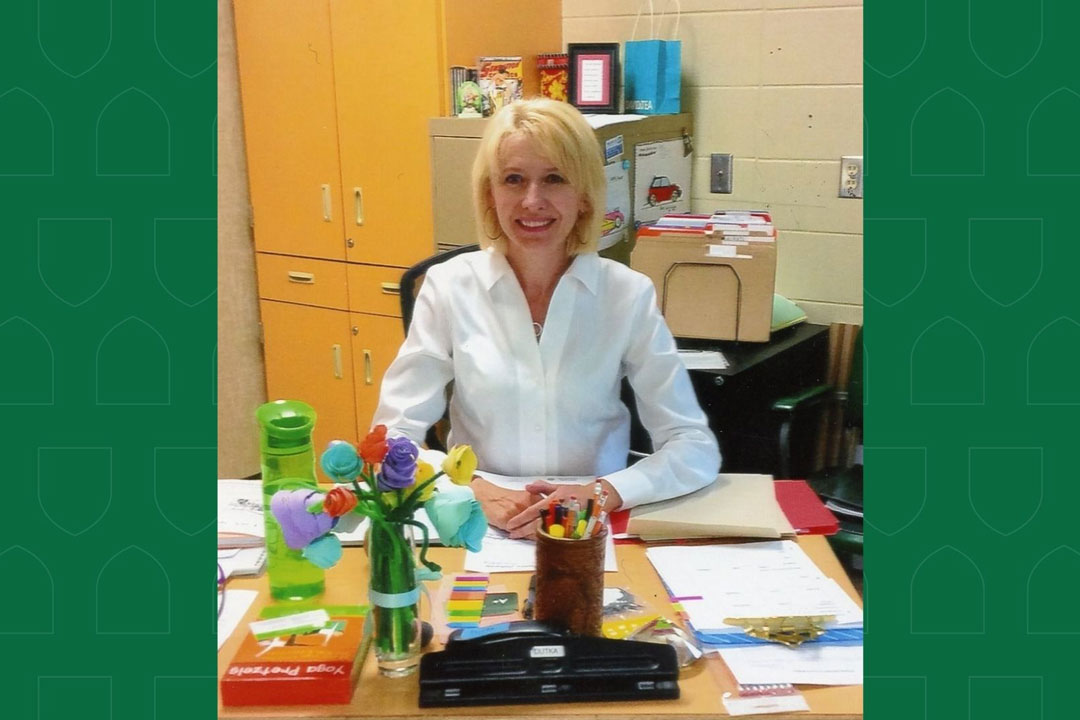
‘I want to be remembered for providing that safe place’
Coreen Dutka (BEd’89, MEd’15) is reflecting on her 32-year teaching career as she prepares for the next chapter of her life.
By Connor JayA product of Herbert, Sask., Dutka left the small town in 1985 to pursue an education degree at the University of Saskatchewan (USask). She knew she wanted to be an elementary school teacher, but happenstance also guided her toward special education.
“My heart was always with the one or two students that didn’t quite fit in, didn’t have everything perfectly lined up academically, or needed some extra support,” Dutka said. “I got involved with the Exceptional Student Society through Professor Gladene Robertson (BEd’65, MEd’74) as I always found that interest and affinity for students who needed a little extra support.”
Following graduation, Dutka taught all K-8 grades across Saskatchewan. Her journey took her to Abbey, Delisle and Langham before she took a break to start a family. When her sons were older, she returned to teaching in Clavet, where she led her first special education program.
“I would often have students who needed support from an educational assistant in my class,” she said. “I was learning the best ways to integrate students and have them take part in all mainstream activities.”
A conversation with Dr. Beverley Brenna (BEd’84, MEd’91, BA'02) about the need for a Saskatoon Public Schools program for students diagnosed with autism led Dutka to the Autism Resource Program (ARP). She launched the first ARP at Evan Hardy Collegiate in 2006.
“Evan Hardy principal John Dewar advised, ‘This is a completely new program and I don’t know exactly what you will do, but I believe in you, so go for it,’” she recalled. “That trust opened up a canvas to do what I thought was best.”
The Evan Hardy ARP found success under Dutka, and she was later tapped to start another program at Marion Graham Collegiate in 2013.
“The Evan Hardy program grew from around five students in the first year to about 10 the next,” Dutka said. “It continued to grow incrementally until it reached 25 students. That’s when it was time to create another program.”
While completing her master’s degree between 2013 and 2015, Dutka built strong connections with Dr. Louise Humbert (PhD) and Dr. Brenda Callan (PhD). Those relationships and the research supported the approaches she was incorporating in the classroom.
“It was that connection to a niche research area where we could see what we could bring into practice,” she said. “They asked me to consider what I was already doing and how it could be expanded.”
In 2024, Dutka launched her third ARP at Bedford Road Collegiate. She emphasizes four key areas: academics, social skills, regulation, and career and community connections. These elements, alongside the locally developed Bridges curriculum, help create a supportive learning environment.
“A resource room like this should be partly available to help with curricular classes,” she said. “But there are also other supports for students on the spectrum, including social thinking and social skills. This includes where to sit at lunchtime, how to do group work, having a quiet place to work, or adapting an exam.”
“Occupational therapy became part of the programming and this led to the development of a regulation program,” she added. “That’s the best way to get students to a calm, focused and alert space.”
“The fourth piece I’ve focused on is career and community connections. Some students want to ride the bus or go for coffee with friends after school. We teach those soft skills that students on the spectrum may not pick up on right away.”
Dutka typically spends about an hour each day with her students. Her goal is to help them become self-sufficient through building confidence to ask questions, connect with others, and gradually reduce their reliance on support.
Through her life-skills-focused teaching, Dutka does not always hear about her students’ progress after Grade 12. Recently, however, she learned about the success of a former student.
“The student emailed me a couple of days ago and showed me his five-year pin from work,” she said. “That is amazing. It means he’s managing people, the public, and workplace demands. Those are things that can’t be taught directly in a resource room.”
Dutka will retire at the end of the 2025/26 school year and is looking forward to what comes next. She plans to transition gradually into substitute teaching or adult education, while pursuing creative writing, travelling, and spending time with her family.
As her teaching chapter closes, Dutka’s legacy will remain with the students she supported.
“I want to be remembered for providing that safe place,” she said. “Someone who cheered for them, who worried about them, and happened to be their teacher. Ultimately, I hope that my students felt that they were valued and that they belonged.”