


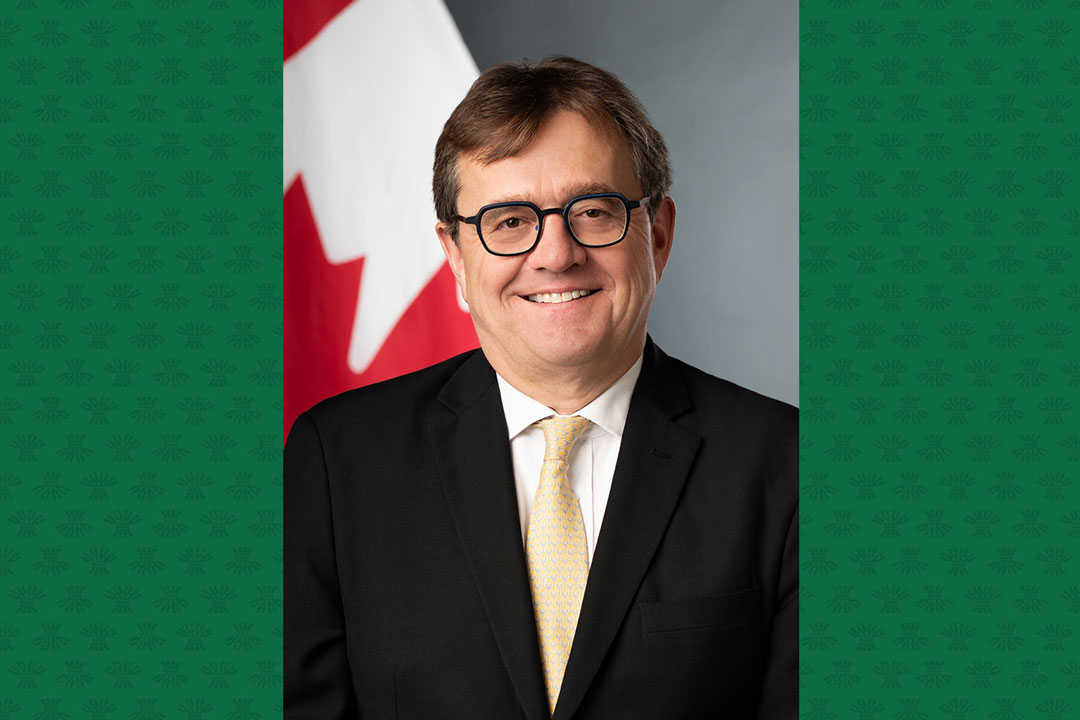
‘This is an enormously interesting role’: USask alumnus Jonathan Wilkinson appointed as Canada’s ambassador to the European Union
Wilkinson (BA’88), who earned a political studies degree at USask’s College of Arts and Science, previously served as an MP and cabinet minister
By SHANNON BOKLASCHUKThe Honorable Jonathan Wilkinson’s outstanding career in politics and public service can be traced back to his time as an undergraduate student at the University of Saskatchewan (USask), where he earned a degree in political studies in 1988.
Wilkinson, who was raised in Saskatoon, Sask., knew that USask would be a great fit for him after high school, given the university’s beautiful campus, its friendly student body, and the “top-notch” professors teaching political science and international relations.
“Honestly, I looked at a bunch of universities when I was finishing high school, but I really loved Saskatchewan and I thought the university was beautiful and it’s one of the better universities in the country,” he said in a recent interview with the Green&White.
As an undergraduate student in USask’s College of Arts and Science, Wilkinson became involved in activities on campus, including serving as the president of the Saskatchewan Young New Democrats. After leading the Saskatchewan NDP’s youth wing, Wilkinson went on to become a federal-provincial relations specialist for former Saskatchewan NDP Premier Roy Romanow (BA’60, LLB’64, LLD’07), a fellow USask alumnus and friend whom Wilkinson continues to visit when he returns to Saskatchewan.
Wilkinson excelled academically at USask and, after graduating with his Bachelor of Arts degree, he studied as a Rhodes Scholar at the University of Oxford in England before embarking on graduate studies at McGill University in Montreal, Que., ultimately earning master’s degrees in international relations, politics, and economics. Since then, Wilkinson’s career has included several decades of experience at the intersection of public policy, technology, and international economic engagement, including serving as Canada’s Minister of Fisheries, Oceans, and the Canadian Coast Guard, Minister of Environment and Climate Change, and Minister of Energy and Natural Resources.
Wilkinson was first elected to the House of Commons in 2015 as the Liberal Member of Parliament for the riding of North Vancouver—Capilano, which he represented until earlier this year, when he resigned to take on a new diplomatic role. On April 30, 2026, Prime Minister Mark Carney announced that Wilkinson had been named the new Ambassador of Canada to the European Union (EU), and Wilkinson officially began working in that capacity over the summer.
Wilkinson is now based in Brussels, Belgium, the de facto capital of the European Union, where he is focused on strengthening and expanding Canada’s relationship with the EU.
“Prime Minister Carney asked me to come here, and it was largely, I think, because he sees the European Union as a key partner moving forward. He sees it as a key partner in the sense of Canada becoming more resilient and less reliant on one single trading and security partner. And so, I came here to do that, and, honestly, it’s been fascinating,” Wilkinson told the Green&White in an interview from Brussels.
“This is an enormously interesting role at this point in time, trying to build a much closer partnership with the European Union, but also thinking about how you can use that as a steppingstone to build a relationship with other countries beyond the European Union that share values that we hold dear, like multilateralism, and democracy and democratic institutions, and a rules-based order. And, so, this is kind of the first step of trying to create an alternative in the global community.”
The EU is Canada’s second‑largest global trading partner for goods and services, with a total value of approximately $178 billion in 2025. The Government of Canada has repeatedly stated that it is working with its European partners “to create greater certainly, security, and prosperity for our peoples;” to that end, Prime Minister Carney travelled to Strasbourg, France, in September 2026, where he addressed the European Parliament, attended European Commission President Ursula von der Leyen’s State of the European Union address, and met with members of the European Parliament. During that same trip to Europe, Carney also travelled to Liverpool, United Kingdom, where he met with Prime Minister Andy Burnham of the UK for the first time.
People who follow the daily news will notice that the bonds between Canada and the EU do appear to be strengthening. Recently, for example, the EU proposed the notion of opening the door for Canada to become its first associate member—a move that came following Carney’s highly regarded speech in January 2026 at the 56th World Economic Forum in Davos, Switzerland, where he received a rare standing ovation.
Wilkinson observed that in the few months he’s been in Brussels, “enormous progress” has been made in building closer relationships with key people in European Union institutions, noting that “Canada’s pretty popular in Europe right now.” Later this month, from Oct. 29 – 30, 2026, Canada will host the Canada-EU Summit in Montreal. Wilkinson said a lot of work has been done in preparation for the summit, and he expects to see “some very concrete signs of progress” following the meeting this month.
“I think all of the work we’ve done, honestly, will come to fruition in October,” he said.
When asked about Canada’s current position on the world stage, Wilkinson agreed that “it’s very interesting times.” He acknowledged that Canada has “had some challenges with our American neighbours in the last little while,” as evidenced by the tariffs imposed by U.S. President Donald Trump, who also made headlines when he signed an executive order to rename Lake Ontario to “Lake America.” Despite those recent developments, Wilkinson said Canada “will always need to have a constructive relationship with the United States, just by dint of geography but also history and relationships.”
“Many of us have family that are still living in the United States. It’s bumpy right now, but eventually we will come through this,” Wilkinson said.
“But I do think the one thing that Canadians have learned is we allowed ourselves to become too dependent on one partner and that’s never a healthy relationship, irrespective of who that partner is,” he added. “So, we are in the process of trying to diversify our relationships and that’s particularly true with countries with whom we share these values that are really important.
“In that context, the work that we are doing with the EU is the beginning of that. But I would tell you, in some senses, we’re pushing on an open door. Canada is very popular around the world for a whole range of reasons that includes we are perceived to be honest brokers. When you do a deal with Canada, it’s a deal. We actually approach things in a calm and measured way, and people, generally, are happy to deal with us. But it’s also the case the prime minister’s speech in Davos really resonated everywhere and I think many in Europe look to that speech and say, ‘Yeah, we can do something. We don’t necessarily have to be in a position where we can be dominated by a much larger country.’ And, so, people are really interested in talking to us and they’re interested in working with us, and that’s a good place to be.”
Wilkinson said Canada can forge strong relationships with other countries around the world even if they are not geographically close. That’s even more true these days, he said, when so much work is done virtually rather than in person, and there is growth in areas such as artificial intelligence, supercomputing, and digital technologies.
“Distance doesn’t really make much difference these days in those types of areas, so that helps. Yes, we think about the United States more because they are proximate, but increasingly we’re going to be looking to try to actually encourage people to also think this way and also to some elements of Asia, for sure,” said Wilkinson.
“Part of that is about getting businesses to think about actually expanding and getting Europeans to think about coming here, but it’s also about building stronger ties between our people. One of the things the prime minister said during his speech was that Canada would look to join a program called Erasmus+, which is about youth experience.”
Erasmus+ is a European Union student exchange program. As someone who has travelled internationally, Wilkinson said his own personal advice for current and prospective Canadian university students, including USask students, is to find opportunities to travel or to study abroad.
“I actually think that’s really important to broaden their perspective, but also I think it’s really important because you actually appreciate Canada a lot more when you leave,” he said. “I often think that if we sent every Canadian outside of Canada for a year, people would recognize how special Canada is.”
When asked about career advice for university students and new graduates, Wilkinson said his view is that “people should be careful about getting hung up on money, on titles, on all of that kind of stuff.” Rather, they should figure out what inspires them and what they really want to do, he said.
“It’s cliché to say at the end of your life you’re going to look back and you’re not going to say, ‘I wish I had another dollar,’ but it’s true. At the end of the day, you should live your life by pursuing the things that animate you—and, at the point at which they don’t animate you, figure out what else you want to do.”
Wilkinson has followed his own advice. Earlier in his career, for example, he worked as a constitutional negotiator before spending more than 20 years in the private sector. He held leadership positions with several companies that were dedicated to the development of clean technologies, which aligned with his passion for the environment and for sustainability. He also worked at a global management consultancy before entering political life as an MP.
Wilkinson said he was drawn to politics because of his concerns about climate change. By becoming an MP, he hoped he could make a difference in that area.
“I would say that I was very fortunate, because I was initially Minister of Fisheries and Oceans and the Canadian Coast Guard but then I became the Minister of the Environment and Climate Change, and I actually got to bring forward a Climate Plan for Canada, which is something that I was very proud of,” Wilkinson said. “I ended up then becoming Canada’s Minister of Energy and Natural Resources, and I brought forward Canada’s Critical Minerals Strategy and its electricity strategy and a range of things that are actually about building an economy. That is about the energy transition, but it’s also about the whole economy.
“Now I think, at this point, I am given the opportunity to work on what I think is perhaps the most important geopolitical issue facing Canada—of course, the other one being the relationship with the United States. I’m proud to represent Canada in that endeavour.”
Although now based in Brussels, Wilkinson maintains close ties to Saskatchewan. His parents continue to live in Saskatoon, while his sister lives in Regina. Wilkinson’s parents previously owned a fishing and canoeing outfitting business north of La Ronge, in the Missinipe area, and Wilkinson returns to Saskatchewan to canoe in the summers alongside his youngest daughter.
“We typically go to Missinipe and we fly on a float plane into a remote river and we canoe back together for a week where we don’t see anybody,” he said.
Wilkinson is proud of Saskatchewan, and he said Saskatchewan people are making a difference at home and around the world. He said USask is recognized for its expertise in water research, agriculture, veterinary medicine, synchrotron science, and many other areas, and he noted that “many of the things that we actually define as being Canadian come from Saskatchewan.”
“Medicare came from Tommy Douglas. Public pensions came from Saskatchewan. A whole range of things that actually ended up being Canadian things are actually Saskatchewanian, originally,” Wilkinson said. “That’s true in the business community, too. Saskatchewan provides potash to the world. We are the largest producer of uranium, and we actually help create energy around the world, and the food from Saskatchewan feeds markets everywhere.”
When talking about his advice for university students and young alumni, Wilkinson urged them to do what they can to contribute to the wellbeing of others. He is proud of his local roots, and he carries the lessons he learned in Saskatchewan with him as he travels and works throughout Canada and around the globe.
“I’ve always thought that part of being a good member of the community is actually going above and beyond to do things that give back. And you can give back in all kinds of different ways—through philanthropic work, through working in an NGO, through working in an academic institution, through politics, in the business community,” Wilkinson said.
“I think an important part of actually having a happy life is thinking that you’re doing something that is bigger than yourself,” he added.